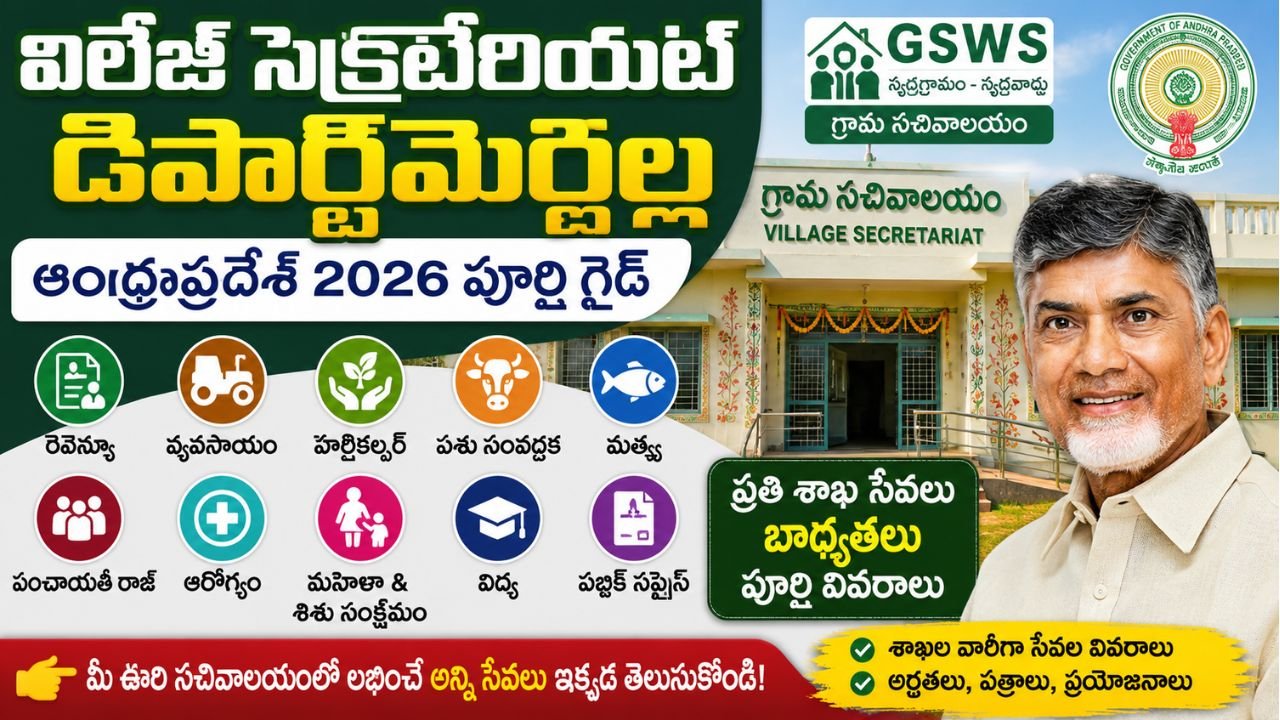
Village Secretariat Departments in Andhra Pradesh (2026)
The Village Secretariat Departments are the foundation of the Grama Sachivalayam system in Andhra Pradesh. Every Village Secretariat brings together multiple government departments under one roof to ensure that citizens can access essential public services without travelling to different government offices.
Each department is responsible for delivering specific government services, implementing welfare schemes, maintaining public records, and assisting citizens with applications, certificates, and grievances. This integrated system helps improve transparency, accountability, and service delivery at the grassroots level.
Through the Village Secretariat, the Government of Andhra Pradesh aims to make governance more accessible, citizen-friendly, and efficient by coordinating the work of various departments at the village level.
Home Page:
https://swarnagramam.co.in/
What are Village Secretariat Departments?
Village Secretariat Departments are government departments that function through the Grama Sachivalayam to provide services directly to rural citizens.
Instead of approaching multiple offices separately, residents can visit their nearest Village Secretariat to obtain guidance, submit applications, enquire about government schemes, and access a wide range of public services.
Each department works within its own area of responsibility while coordinating with other departments whenever required.
Objectives of Village Secretariat Departments
The Village Secretariat Departments are established to achieve the following objectives:
- Deliver government services closer to every citizen.
- Improve transparency in public administration.
- Reduce delays in service delivery.
- Strengthen rural governance.
- Ensure effective implementation of government welfare schemes.
- Improve coordination among government departments.
- Support digital governance initiatives.
- Provide timely grievance redressal.
- Increase accessibility to citizen services.
- Promote accountable and efficient administration.
Why Village Secretariat Departments are Important
Village Secretariat Departments play a significant role in improving governance across Andhra Pradesh.
Some of the key advantages include:
- Easy access to government services.
- Better coordination among departments.
- Faster processing of citizen requests.
- Improved implementation of welfare programmes.
- Greater transparency in administration.
- Better monitoring of government schemes.
- Increased public awareness.
- Improved service delivery through digital platforms.
- Reduced need for repeated visits to government offices.
- Citizen-centric governance at the village level.
Major Village Secretariat Departments
The following departments support the functioning of Village Secretariats and provide various government services to citizens.
Revenue Department
The Revenue Department handles many important administrative services and supports the implementation of government programmes.
Major responsibilities include:
- Revenue administration support.
- Public service coordination.
- Certificate-related guidance.
- Beneficiary verification.
- Government record maintenance.
- Citizen grievance assistance.
- Coordination with district revenue authorities.
Panchayat Raj Department
The Panchayat Raj Department is responsible for village infrastructure and local civic development.
Its functions include:
- Rural infrastructure development.
- Village sanitation.
- Drinking water facilities.
- Roads and drainage maintenance.
- Public asset management.
- Community development activities.
Agriculture Department
Agriculture is one of the most important sectors in rural Andhra Pradesh.
The Agriculture Department supports farmers through:
- Agricultural awareness.
- Government agriculture schemes.
- Crop advisory programmes.
- Farmer welfare initiatives.
- Sustainable farming awareness.
- Agriculture-related public services.
Horticulture Department
The Horticulture Department promotes cultivation of fruits, vegetables, spices, flowers, and plantation crops.
Its responsibilities include:
- Horticulture development programmes.
- Farmer awareness.
- Government subsidy information.
- Crop diversification guidance.
- Plantation development.
Animal Husbandry Department
The Animal Husbandry Department supports livestock owners by promoting animal health and productivity.
Major services include:
- Livestock development programmes.
- Veterinary awareness.
- Dairy development support.
- Poultry development guidance.
- Government livestock schemes.
Fisheries Department
The Fisheries Department promotes fisheries development and supports eligible fishing communities.
Its major responsibilities include:
- Fisheries welfare programmes.
- Aquaculture awareness.
- Government fisheries schemes.
- Beneficiary guidance.
- Fisheries development initiatives.
Rural Development Department
The Rural Development Department focuses on improving livelihoods and rural infrastructure.
Important functions include:
- Rural development programmes.
- Community development initiatives.
- Self Help Group support.
- Employment programme awareness.
- Government welfare implementation.
Civil Supplies Department
The Civil Supplies Department supports the Public Distribution System (PDS).
Services generally include:
- Ration card guidance.
- Public Distribution System awareness.
- Essential commodity distribution support.
- Fair Price Shop information.
- Beneficiary services.
Health Department
The Health Department promotes public health and supports healthcare programmes.
Its major functions include:
- Public health awareness.
- Preventive healthcare.
- Government health schemes.
- Immunization awareness.
- Maternal and child health programmes.
- Community health initiatives.
Women and Child Welfare Department
This department focuses on improving the welfare of women and children.
Responsibilities include:
- Women welfare programmes.
- Child development initiatives.
- Nutrition awareness.
- Government welfare scheme support.
- Community awareness activities.
Education Department
The Education Department supports educational development within villages.
Its responsibilities include:
- Student welfare programmes.
- Government scholarship awareness.
- School education support.
- Educational development initiatives.
- Public education awareness.
Engineering Department
The Engineering Department assists with infrastructure-related activities.
Major responsibilities include:
- Public infrastructure.
- Water supply coordination.
- Village development works.
- Technical support.
- Maintenance of public assets.
Energy Department
The Energy Department supports electricity-related public services.
Functions include:
- Rural electrification awareness.
- Coordination with electricity service providers.
- Government energy initiatives.
- Citizen guidance regarding electricity-related services.
Social Welfare Department
The Social Welfare Department supports various welfare programmes for eligible beneficiaries.
Its responsibilities include:
- Welfare scheme awareness.
- Educational support programmes.
- Social assistance initiatives.
- Government beneficiary guidance.
Backward Classes Welfare Department
This department implements welfare programmes for eligible Backward Classes communities.
Its services include:
- BC welfare scheme awareness.
- Educational assistance.
- Economic development programmes.
- Beneficiary support.
Scheduled Castes Welfare Department
The department supports welfare initiatives for Scheduled Castes.
Major functions include:
- Welfare scheme implementation.
- Educational assistance.
- Government beneficiary support.
- Community development initiatives.
Scheduled Tribes Welfare Department
The Scheduled Tribes Welfare Department promotes the welfare and development of tribal communities.
Its responsibilities include:
- Tribal welfare programmes.
- Educational support.
- Government scheme awareness.
- Community development.
Minority Welfare Department
The Minority Welfare Department supports minority communities through various welfare initiatives.
Major responsibilities include:
- Minority welfare schemes.
- Educational assistance.
- Scholarship awareness.
- Economic development initiatives.
- Citizen support services.
Labour Department
The Labour Department works to improve the welfare of workers by implementing labour-related government programmes and creating awareness about social security initiatives.
Major responsibilities include:
- Labour welfare awareness.
- Worker registration guidance.
- Unorganized worker welfare information.
- Government labour scheme assistance.
- Awareness on labour rights and benefits.
- Coordination with the concerned labour authorities.
Youth Services Department
The Youth Services Department focuses on empowering young people through skill development, leadership programmes, and employment-related initiatives.
Its functions include:
- Youth development programmes.
- Skill development awareness.
- Career guidance initiatives.
- Sports and youth welfare activities.
- Government employment programme awareness.
Disaster Management Department
The Disaster Management Department helps villages prepare for natural disasters and emergency situations.
Major responsibilities include:
- Disaster preparedness.
- Emergency response coordination.
- Flood and cyclone awareness.
- Relief programme support.
- Public safety campaigns.
- Coordination with district authorities during emergencies.
Department-wise Services at a Glance
| Department | Primary Services |
|---|---|
| Revenue | Revenue administration, certificates, beneficiary verification |
| Panchayat Raj | Roads, sanitation, drinking water, village infrastructure |
| Agriculture | Farmer welfare, agriculture guidance, crop awareness |
| Horticulture | Horticulture development and government schemes |
| Animal Husbandry | Livestock development and veterinary awareness |
| Fisheries | Fisheries welfare and aquaculture support |
| Rural Development | Rural development programmes and SHG initiatives |
| Civil Supplies | Public Distribution System and ration-related services |
| Health | Public health programmes and awareness |
| Women & Child Welfare | Nutrition, women welfare and child development |
| Education | Student welfare and educational awareness |
| Engineering | Infrastructure development and public works |
| Energy | Electricity-related public coordination |
| Social Welfare | Welfare schemes for eligible beneficiaries |
| BC Welfare | Welfare programmes for Backward Classes |
| SC Welfare | Welfare programmes for Scheduled Castes |
| ST Welfare | Welfare programmes for Scheduled Tribes |
| Minority Welfare | Minority welfare and scholarship awareness |
| Labour | Labour welfare and worker-related schemes |
| Youth Services | Skill development and youth programmes |
| Disaster Management | Emergency preparedness and disaster response |
How Village Secretariat Departments Work Together
Village Secretariat Departments function as an integrated system rather than as isolated units. Many citizen services require coordination between multiple departments to ensure smooth processing.
For example:
- Welfare scheme applications may require verification from the Revenue Department and eligibility confirmation from the concerned welfare department.
- Rural infrastructure projects involve coordination between Panchayat Raj, Engineering, and Rural Development departments.
- Health awareness programmes are implemented jointly by the Health and Women & Child Welfare departments.
- Agriculture-related initiatives often involve Agriculture, Horticulture, Animal Husbandry, and Fisheries departments.
This coordinated approach improves efficiency and ensures that services are delivered effectively.
Benefits of Village Secretariat Departments
The department-based structure provides several advantages to citizens and the government.
For Citizens
- Easy access to multiple government services at one location.
- Reduced travel to different government offices.
- Better guidance for government schemes.
- Faster processing of eligible applications.
- Improved transparency in service delivery.
- Better grievance support.
- Increased awareness of government programmes.
For Government
- Better coordination among departments.
- Improved implementation of welfare schemes.
- Efficient monitoring of service delivery.
- Accurate maintenance of government records.
- Strengthened rural governance.
- Enhanced public accountability.
Digital Governance in Village Secretariats
The Government of Andhra Pradesh continues to strengthen digital governance through the GSWS ecosystem. Digital systems help departments process applications, maintain records, coordinate with district offices, and improve citizen service delivery.
Digital initiatives support:
- Online application submission.
- Digital verification processes.
- Application status tracking.
- Electronic record management.
- Departmental coordination.
- Improved transparency.
- Faster communication between offices.
Documents Commonly Required
Depending on the service requested, citizens may need to submit one or more of the following documents:
- Aadhaar Card
- Ration Card
- Mobile Number
- Passport-size Photograph
- Address Proof
- Income Certificate
- Caste Certificate
- Residence Certificate
- Bank Account Passbook
- Land-related documents (where applicable)
- Any additional supporting documents required for the specific service
Tips Before Visiting a Village Secretariat
To make your visit more productive:
- Carry all required original documents.
- Keep photocopies ready if needed.
- Ensure your Aadhaar details are updated.
- Carry your registered mobile number.
- Verify eligibility before applying for a scheme.
- Keep the application acknowledgement safely.
- Follow only official government instructions and notifications.
Frequently Asked Questions
What are Village Secretariat Departments?
Village Secretariat Departments are government departments that provide public services and implement welfare programmes through the Grama Sachivalayam system in Andhra Pradesh.
Can I access multiple government services at one Village Secretariat?
Yes. Village Secretariats coordinate services from multiple departments, making it easier for citizens to access government services at a single location.
Which department handles agriculture-related services?
Agriculture-related services are generally coordinated by the Agriculture Department through the Village Secretariat.
Does the Village Secretariat help with welfare schemes?
Yes. Citizens can obtain information, eligibility guidance, and application support for various government welfare schemes through the relevant departments.
Are Village Secretariat Departments connected through digital systems?
Yes. Many services are supported through the Government of Andhra Pradesh’s digital governance platforms to improve efficiency and transparency.
Where can I find official information about Village Secretariat services?
Citizens should always refer to the official Government of Andhra Pradesh and GSWS portals for authentic and updated information.
Official Andhra Pradesh Government Links
- GSWS Official Portal: https://gsws.ap.gov.in/
- GSWS Citizen Portal: https://vswsonline.ap.gov.in/
- Government of Andhra Pradesh: https://ap.gov.in/
Related Pages
- GSWS (Swarna Gramam Swarna Wardu)
- Village Secretariat Andhra Pradesh
- Ward Secretariat Andhra Pradesh
- GSWS Services
- GSWS Citizen Services
- Village Secretariat Functions
- Village Secretariat Staff
- Village Secretariat Login
- GSWS Application Status
- GSWS Certificates
Conclusion
The Village Secretariat Departments play a central role in delivering government services and implementing welfare programmes across rural Andhra Pradesh. By bringing multiple departments together under the Grama Sachivalayam framework, the Government has made essential public services more accessible, transparent, and efficient for citizens.
Whether it is agriculture, health, education, civil supplies, revenue, rural development, or welfare programmes, each department contributes to strengthening grassroots governance and improving the quality of public service delivery. For the latest updates, service availability, and official procedures, citizens should always refer to the official GSWS and Andhra Pradesh Government portals and contact their nearest Village Secretariat when required.